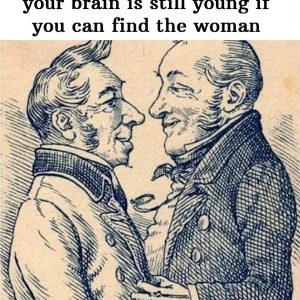
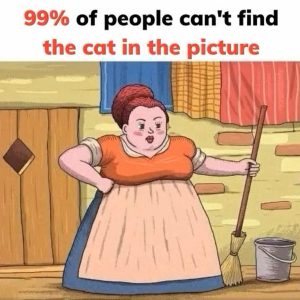
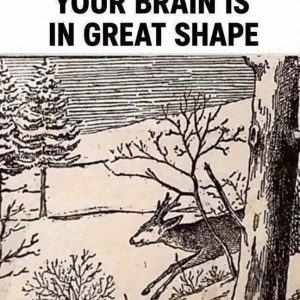
The chicken is right there. You’ve been staring at the men, the rocks, the cave, convinced you’ve seen everything—yet somehow you missed the one thing you were told to find. That tiny failure nags at you. Why didn’t your brain catch it? Why did your eyes seem to lie? And what else, every day, are you looking directly at without actually seeing?
That’s what makes hidden-picture puzzles so addictive. Your eyes collect enormous amounts of visual information, but your brain has to decide what deserves attention. Instead of carefully examining every shape, shadow, and line, it searches for familiar patterns. A face becomes a face. A rock becomes a rock. A tree becomes a tree.
And that shortcut usually works brilliantly.
Until someone hides a chicken where your brain doesn’t expect one.
Suddenly, an ordinary curve may become a beak. A patch of darkness could form a wing. Two unrelated lines might create the outline you’ve been searching for all along. Once you finally recognize it, something even stranger happens: you may find it almost impossible not to see it again.
That “How did I miss that?” moment is the real fun.
It doesn’t mean you have poor eyesight or that something is wrong with your observation skills. Visual puzzles deliberately take advantage of attention, expectations, contrast, and pattern recognition to make familiar objects difficult to notice.
So look at the picture one more time.
Forget the obvious people. Stop searching for a perfectly drawn chicken. Examine the negative spaces, unusual outlines, and shapes that seem to belong to something else.
Still can’t find it?
Give your eyes another few seconds.
Because once that chicken finally appears, you’ll wonder how it ever managed to hide from you.