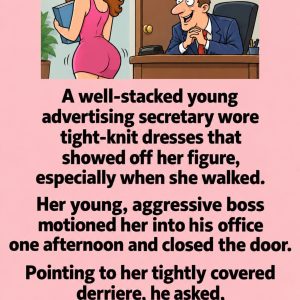
The secretary stared at him, visibly irritated. Her boss had pointed toward her tightly fitted outfit and asked whether what she was displaying was “for sale.” The question caught her completely off guard, and she quickly responded that it absolutely was not.
For a moment, it seemed as though the conversation might become even more uncomfortable. She expected him either to explain himself or apologize for asking something so personal. Instead, he remained calm, apparently already knowing exactly what he wanted to say next.
Without changing his expression, the boss delivered the punchline: “Then, I suggest you quit advertising it.” His remark turned the entire exchange into an old-fashioned workplace joke built around the fact that both characters worked in advertising.
Of course, viewed through modern workplace standards, a boss commenting on an employee’s body or clothing in this manner would be inappropriate rather than professional advice. But the story itself is presented as a short joke, with the humor depending on the double meaning of “advertising”—first referring to their profession and then to the boss’s final remark about her outfit. What begins as an uncomfortable conversation therefore ends with a quick play on words, providing the twist the joke has been building toward from the moment the secretary enters the office.




This Post Has One Comment