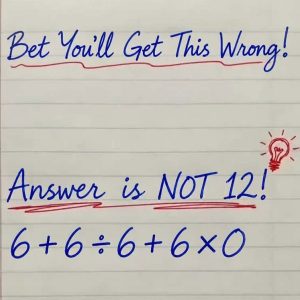
The correct answer to this puzzle is 7, and understanding why requires following the standard order of operations. In mathematics, this rule is commonly remembered using the abbreviations PEMDAS or BODMAS. Both help us remember that multiplication and division must be completed before addition and subtraction, unless parentheses or other higher-priority operations change the order.
Let’s begin with the original expression: 6 + 6 ÷ 6 + 6 × 0. The first step is to calculate the division because it appears before the multiplication when reading from left to right. Six divided by six equals one. That means our expression becomes 6 + 1 + 6 × 0. We still cannot add everything together because one multiplication operation remains.
Next, calculate six multiplied by zero. Any number multiplied by zero equals zero, so this part of the expression becomes zero. Now the equation reads 6 + 1 + 0. With the multiplication and division completed, we can finally perform the addition. Six plus one equals seven, and adding zero doesn’t change the result. Therefore, the final answer is 7.
What makes this puzzle entertaining is how easily our brains can overlook familiar mathematical rules when we’re trying to answer quickly. Some people calculate everything from left to right without considering the priority of operations. Others assume that multiplying by zero automatically makes the entire equation zero, even though the multiplication applies only to one part of the expression. Taking a few extra seconds to follow the correct steps can make all the difference.
Be honest — did you get 7 on your first try, or did you come up with a different answer? Share your result in the comments!




This Post Has One Comment