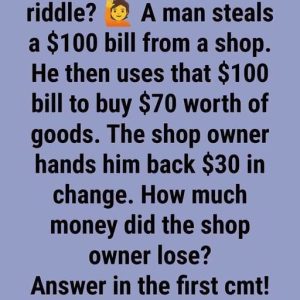
This classic shopping puzzle has confused countless people because it involves several transactions using the same $100 bill. At first, the customer steals $100 from the cash register, leaving the shopkeeper short of that amount. Naturally, many people immediately count the stolen money as the first loss. But the story doesn’t end there. The customer later returns to the shop and uses the very same bill to purchase $70 worth of merchandise. The shopkeeper accepts the payment, unaware that the money originally belonged to the business. Because the customer hands over $100 for a $70 purchase, the shopkeeper gives back $30 in change.
The trick is understanding what happens to the stolen bill. Once the customer uses it to pay for the merchandise, that original $100 returns to the cash register. It is no longer missing. However, the customer leaves with $70 worth of products and an additional $30 in cash. Those are the two things the shopkeeper has permanently lost. The merchandise is gone, and the change has been handed over. When you add the value of those items together, the result is $100. This assumes the merchandise is valued at its stated $70 selling price, as the puzzle intends.
Some people answer $200 because they count the original $100 theft, the $70 in merchandise, and the $30 in change. But this counts the same $100 bill twice. Others arrive at $170 by combining the stolen money and the merchandise without recognizing that the stolen bill was returned. The easiest way to avoid confusion is to ignore the individual movements for a moment and examine the shopkeeper’s final position. The cash register has received its original $100 bill back but has lost $30 in change. The store has also lost $70 worth of merchandise. Together, those losses equal exactly $100.
The puzzle is a great example of why logical thinking matters more than rushing to add every number we see. Our brains sometimes focus on the most dramatic detail — in this case, the theft — and overlook how later events change the situation. By carefully following the money from beginning to end, the solution becomes much easier to understand. It’s the kind of brain teaser that can spark lively debates between friends and family, especially when everyone feels certain their answer is correct. And sometimes, the people who answer most confidently are the ones who overlook the simplest explanation.
🧠 The correct answer is $100!
💵 But be honest — what was YOUR first answer?
A — $100
B — $130
C — $170
D — $200
👇 Tell us your answer in the comments and challenge a friend to solve it without a calculator!


This Post Has One Comment