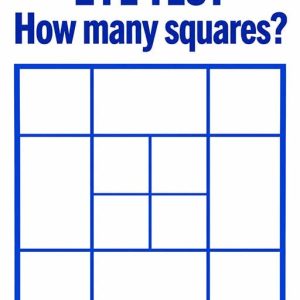
This classic visual puzzle demonstrates how easily our eyes can confuse similar geometric shapes. The image features a large square outline containing several smaller shapes arranged in a symmetrical pattern. At first, it seems natural to count every enclosed section as a square. However, not every four-sided figure qualifies. A square must have four equal sides and four right angles. If a shape is noticeably longer than it is wide, it is a rectangle rather than a square. Remembering this distinction is essential to finding the intended answer.
Begin by examining the center of the image. There, you’ll find four small squares arranged together in a two-by-two pattern. Count each of these individually, giving you a total of four. Next, look at the four corners of the larger design. Each corner contains another square, bringing the running total to eight. But we’re not finished yet. The four small squares in the middle also form one larger square when considered together. That gives us nine squares so far. This is where careful observation becomes especially important, because counting overlapping and combined shapes is part of the challenge.
Finally, look at the outermost boundary of the entire diagram. The large frame is itself a square, adding one more to our total. Now the calculation becomes straightforward: four small central squares, four corner squares, one combined central square, and one large outer square. Add them together and you get 10 squares. What about the other sections along the top, bottom, and sides? Although they may initially appear similar to the squares, their unequal side lengths mean they should be classified as rectangles. Counting those shapes is one reason some people arrive at higher numbers.
The interesting thing about this puzzle is that solving it doesn’t require advanced mathematics. It simply requires patience, attention to detail, and an understanding of what makes a square different from a rectangle. Our brains are very good at recognizing patterns, but sometimes that ability causes us to group similar-looking objects together without examining them individually. Visual challenges like this can be a fun way to practice observation while sharing a friendly competition with family members. Whether you found the answer immediately or needed another look, the important part is understanding the reasoning behind it.
🧠 The intended answer is 10 squares!

This Post Has One Comment