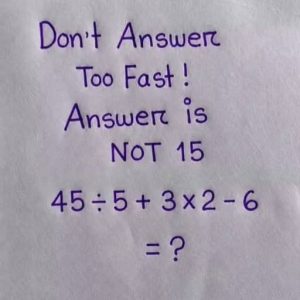
The first thing to remember is the standard order of operations. Multiplication and division must be handled before addition and subtraction. When operations have equal priority, they are calculated from left to right. That means we cannot simply rush through the equation however our eyes happen to read it.
Start with the division: 45 ÷ 5 = 9. Next, calculate the multiplication: 3 × 2 = 6. After completing those two operations, the original equation becomes much simpler: 9 + 6 − 6. Now only addition and subtraction remain, so we work through them from left to right.
First calculate 9 + 6, which equals 15. And this is exactly where the puzzle catches many people. They see 15 and immediately assume they have finished. But look carefully—the final − 6 has not disappeared. Complete that last operation and 15 − 6 = 9. Therefore, the correct answer is 9, not 15.
The complete solution is 45 ÷ 5 + 3 × 2 − 6 = 9 + 6 − 6 = 15 − 6 = 9. There is no complicated mathematical trick hidden inside the puzzle. The challenge is simply resisting the temptation to answer before checking every operation. If you answered 9 immediately, you followed the equation all the way through. If you initially chose 15, you discovered exactly why that warning mattered: sometimes the easiest-looking puzzles are the ones most likely to make us rush.



This Post Has One Comment