The correct answer is surprisingly straightforward once you understand how the family members are connected.
A is D’s granddaughter.
But how do we arrive at that conclusion?
Let’s examine the clues carefully.
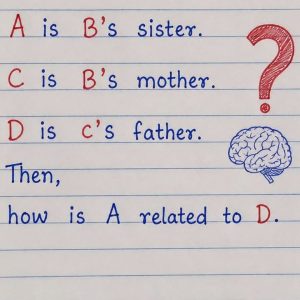
The first statement tells us that A is B’s sister. This establishes that A is female and that A and B are siblings.
The second statement says C is B’s mother. Since A and B are siblings, the puzzle assumes that C is also A’s mother.
Now we know that C has two children: A and B.
The third statement reveals that D is C’s father.
This is where everything begins to make sense.
If D is C’s father, and C is A’s mother, then D must be A’s maternal grandfather.
However, pay close attention to how the question is worded.
It doesn’t ask how D is related to A.
Instead, it asks how A is related to D.
That small difference is important.
Because A is female and D is her grandfather, A must be his granddaughter.
The complete family relationship looks like this:
D → Father of C
C → Mother of A and B
A → Sister of B
Therefore, A → Granddaughter of D.
What makes this puzzle interesting is that it demonstrates how easily people can become confused when several family relationships are presented together.
Instead of following each connection individually, our brains sometimes attempt to jump directly to an answer.
That approach can lead to mistakes, especially when the question changes the direction of the relationship.
A useful strategy for solving similar puzzles is to start with the clearest family connection and work through each generation.
You can even draw a simple family tree to make the relationships easier to understand.
These types of brain teasers are popular because they encourage logical thinking, attention to detail, and careful reading.
And although this particular puzzle contains only three statements, it can still make people stop and think.
FINAL ANSWER: A is D’s granddaughter.
Now that you know the solution, here’s another question:
Did you get the correct answer immediately, or did you have to read the clues twice?
Sometimes the simplest puzzles are the ones that make us think the hardest!



This Post Has One Comment