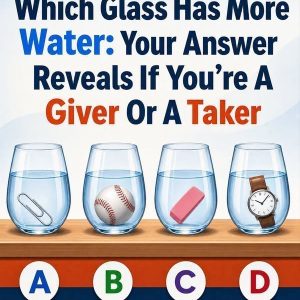
The answer to this popular brain teaser comes from a basic scientific principle known as water displacement. Whenever an object is placed into a glass of water, it occupies space that the water would otherwise fill. If the object is fully submerged, it displaces an amount of water equal to its own volume. That means two identical glasses with the same water level don’t necessarily contain the same amount of actual water when different objects are inside them. A larger submerged object takes up more room, leaving less space for water. A smaller object occupies less room, allowing the glass to contain more water.
In the puzzle, Glass A contains a paperclip, Glass B contains a baseball, Glass C contains an eraser, and Glass D contains a wristwatch. Assuming the glasses are identical, their water levels are equal, and the objects are fully submerged, Glass A is the correct answer. The paperclip takes up the least space, so it displaces the smallest amount of water. The baseball, by comparison, occupies a much larger volume. Even though the visible water levels may look identical, the amount of liquid inside the glasses is different. It’s a clever reminder that what appears equal on the surface may not actually be equal when we examine the details.
The puzzle also demonstrates why careful observation matters. Many people instinctively focus on the height of the water rather than the volume of the objects. Others assume that the heaviest object must displace the most water, but weight alone doesn’t determine displacement when an object is completely submerged. Volume is the important measurement. If an object floats, the explanation changes because a floating object displaces water according to its weight. That’s why the exact conditions of a science puzzle matter. In this particular illustration, the intended solution relies on comparing the space occupied by the four objects.
Beyond the scientific explanation, some versions of this challenge include playful personality interpretations based on which glass you choose first. For example, selecting the smallest object might be associated with noticing subtle details, while choosing a larger object might be described as focusing on the bigger picture. These interpretations can be entertaining conversation starters, but they aren’t scientifically reliable personality assessments. What makes this puzzle worthwhile is the opportunity to think carefully, question first impressions, and learn something about how everyday objects interact with water. Sometimes a tiny paperclip can teach a surprisingly big lesson: the smallest detail can make the biggest difference.

This Post Has One Comment