In recent years, researchers have explored various methods to deepen the understanding and early detection of Autism Spectrum Disorder (ASD). One intriguing approach involves an optical illusion that highlights the cognitive differences often associated with ASD. By observing how individuals perceive moving black-and-white dots, scientists aim to gain insight into the detail-oriented thinking style commonly seen in people on the autism spectrum.
ASD is a neurodevelopmental condition characterized by challenges in social interaction, and communication, and a tendency toward repetitive behaviors or focused interests. Common symptoms include difficulties with social cues, restrictive interests, repetitive actions, sensory sensitivities, and language or communication struggles.
Typically, signs of ASD emerge within the first two years of life, though some children are diagnosed later. According to the Centers for Disease Control and Prevention (CDC), approximately 1 in 36 children in the U.S. was diagnosed with ASD by 2020. Not all individuals with autism-like traits have ASD, but recognizing these traits can facilitate earlier diagnosis and lead to improved treatment and outcomes.

A notable trait among those with ASD is a strong focus on specific details over the broader context. This attention to detail can lead to a preference for routines, specialized interests, and heightened sensory awareness. Understanding these cognitive differences can provide valuable insights into the mechanisms underlying ASD.
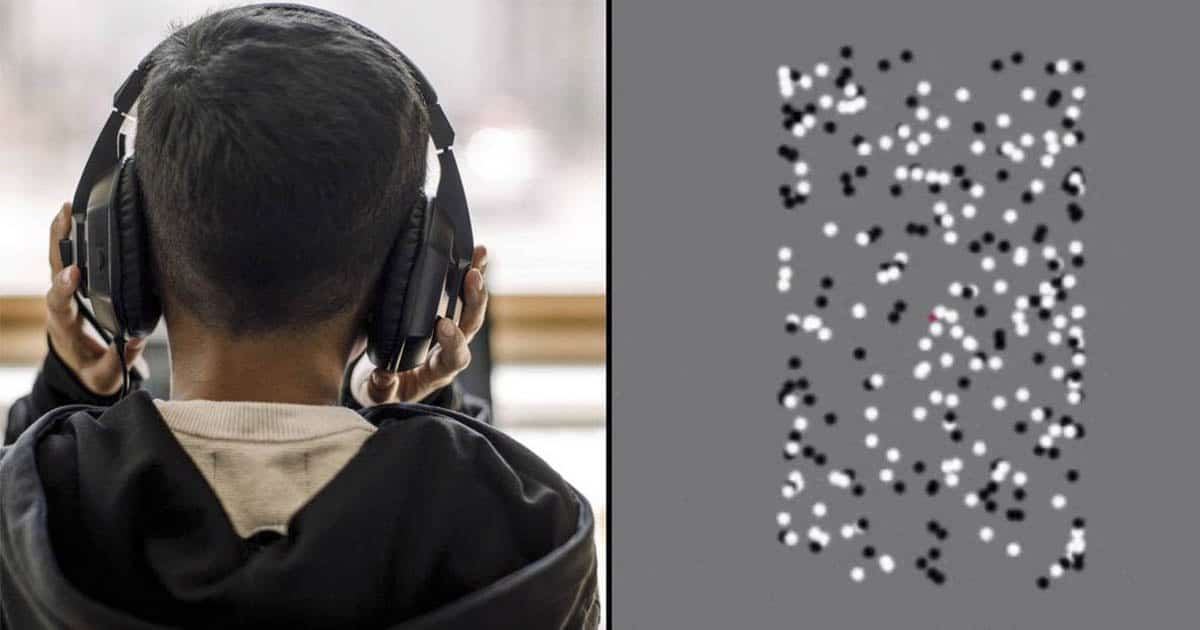
The optical illusion in question consists of black-and-white dots that can appear as two separate sheets moving independently or as a spinning column. This illusion allows researchers to observe how people with and without ASD process visual information. Focusing on each shade separately indicates a detail-oriented perspective, often associated with ASD, while seeing the dots as a unified spinning column suggests a more holistic view.

If you see the illusion as a column spinning, you’re likely perceiving it as a cohesive system, with each dot changing from white to black as it moves. However, if you see two independent sheets moving, it suggests a more detail-oriented focus, a perspective often seen in those with ASD traits. This perception style alone does not indicate ASD.
In one study, researchers observed the eyes of 50 adults without an ASD diagnosis as they viewed the illusion. Instead of asking what they saw, the researchers monitored pupil movements, which flickered when focusing on separate layers. Participants also completed a questionnaire assessing autism-related traits.

The findings showed that individuals who saw the illusion as two sheets tended to score higher on autism-related traits. While the illusion itself is not a diagnostic tool, the study reveals valuable insights into ASD brain function, providing a foundation for further research into autism-related characteristics.
These findings suggest that the attention to detail characteristic of individuals with ASD may extend to how they process visual information. This optical illusion experiment not only advances our understanding of ASD’s cognitive mechanisms but may also aid in the development of future diagnostic tools and treatments.