The secret to solving this puzzle is understanding exactly what happened to the original $100 bill. Many people become confused because they count the same money more than once, making the shopkeeper’s loss appear much larger than it really is.
Let’s examine the situation carefully.
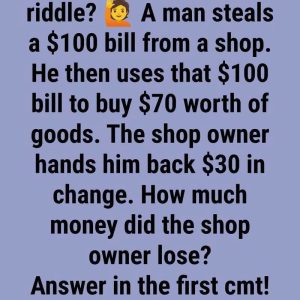
When the thief first entered the store, he removed $100 from the cash register. At that moment, the shopkeeper had lost exactly $100 in cash. Nothing complicated had happened yet.
But when the thief returned, something important changed.
He used the very same $100 bill to purchase merchandise worth $70. The shopkeeper accepted the bill and placed it back into the cash register, meaning the original stolen cash had been returned.
However, the shopkeeper then handed the man $30 in change and allowed him to leave with $70 worth of merchandise.
This is where many people make their mistake.
They add the original stolen $100 to the $70 in merchandise and the $30 in change, concluding that the shopkeeper lost $200.
But that calculation ignores the fact that the original $100 was returned during the purchase.
To understand the actual loss, simply look at what the thief ultimately carried away.
He left with $70 worth of merchandise and $30 in cash.
That means the shopkeeper’s total loss was:
$70 + $30 = $100.
The cash register ended up $30 short, and the store had $70 less merchandise, measured at its stated value.
Together, those losses equal exactly $100.
The interesting thing about this riddle is that it doesn’t require complicated mathematics. Instead, it tests your ability to follow a sequence of events without counting the same amount twice.
Our brains sometimes become distracted by numbers appearing repeatedly, especially when money changes hands several times.
That’s why even people who are excellent at mathematics can initially make the wrong calculation.
The next time you encounter a similar puzzle, remember to focus on what was actually lost rather than adding every transaction together.
Be honest: What was your first answer — $100, $130, $170, or $200? Share it in the comments before checking the explanation!




This Post Has One Comment