The idea that the length of our fingers, particularly the ratio between the index finger (2D) and the ring finger (4D), can reveal something intrinsic about our personality is a fascinating one—though it’s important to recognize that this is rooted in pseudoscience rather than proven science. Still, it’s intriguing to think that such a simple, physical trait might somehow tell us about a person’s tendencies, behavior, or even character. It’s a concept that has captivated many, inspiring countless individuals to look at their hands in a new way and wonder if there’s truth behind the claims.
You see, the “digit ratio,” especially that between the index and ring finger, has gained popularity because of what some call the “2D:4D ratio.” Essentially, if your ring finger is longer than your index finger, you’re thought to be a risk-taker—assertive, ambitious, outgoing, and perhaps even a bit aggressive. People with a lower 2D:4D ratio are often described as confident and competitive, maintaining high self-esteem and a drive to succeed. Conversely, if your index finger is longer, it’s said you tend toward compassion, empathy, and nurturing qualities. Such individuals are believed to be more conscious of others’ feelings and more inclined to avoid conflict, preferring a more cooperative approach to life.
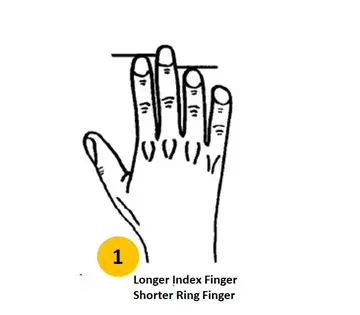
And then, there are the people with fingers that are pretty much of equal length. In those cases, it’s suggested they might exhibit a complex balance—sometimes assertive, sometimes compassionate—adapting to circumstances with ease. This, of course, paints a very simplified picture of human personality, but it’s a picture that has attracted many believers worldwide, especially among those interested in alternative, mystical, or intuitive ways of understanding oneself.
The origins of this concept go back quite a ways, although it gained significant momentum through the work of evolutionary biologist John Manning, who is now at Swansea University. Over the past two decades, Manning has inspired more than 1,400 studies exploring the links between finger ratios and a broad range of traits—cognitive abilities, risk-taking propensity, susceptibility to certain diseases, even aspects related to gender identity. Some researchers have even pointed to ancient cave painters, suggesting that their finger ratios might tell us whether they were more male or female, more assertive or nurturing, based on the pseudoscientific criteria of the time.