What’s the Correct Answer?
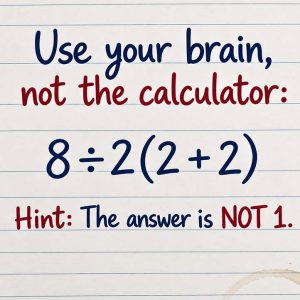
The answer given by the original puzzle is:
16
Here’s how the calculation works.
Step 1: Solve the parentheses.
8 ÷ 2(2 + 2)
Since 2 + 2 = 4, the expression becomes:
8 ÷ 2(4)
Step 2: Understand the multiplication.
The expression 2(4) means 2 × 4.
Therefore, we can rewrite the equation as:
8 ÷ 2 × 4
Step 3: Follow the order of operations.
Here’s where the confusion begins.
Many people believe multiplication must always happen before division.
But that’s not correct.
Multiplication and division have equal priority.
Under the usual left-to-right convention, we calculate whichever appears first.
8 ÷ 2 = 4
Then:
4 × 4 = 16
Why Do Some People Answer 1?
They interpret the expression as:
8 ÷ [2(2 + 2)]
That calculation gives 1.
The original notation is ambiguous enough that different grouping conventions can produce different interpretations. Adding parentheses would make the intended meaning clear.
The Final Takeaway
Using the left-to-right interpretation, the answer is 16, as explained in the original puzzle.
This challenge demonstrates why mathematical notation and the order of operations matter.
What was your first answer: 1 or 16? Share it in the comments!




This Post Has One Comment