The answer begins deep inside a hair follicle.
Our skin naturally produces an oily substance called sebum, which helps keep it moisturized and protected.
At the same time, skin cells are constantly being shed and replaced.
Sometimes, excess oil and dead skin cells collect inside a follicle, creating a plug.
When the opening remains exposed to air, the material at the surface undergoes oxidation, which contributes to its dark appearance.
That’s why blackheads are called open comedones.
And despite what many people believe, their dark color doesn’t mean the skin is dirty.
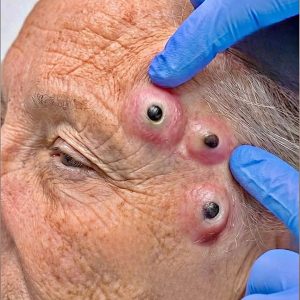
In some cases, a blackhead can become unusually large and persistent.
One particularly noticeable type is known as a dilated pore of Winer, which can resemble a giant blackhead.
These enlarged pores may contain a substantial buildup of keratin and other material.
Although they are generally benign, they can be difficult to remove completely without professional treatment.
This is where many people make a mistake.
After seeing extraction videos online, they may be tempted to squeeze or dig into a large blackhead themselves.
But aggressive squeezing, sharp tools, or repeated picking can injure the skin and increase the risk of inflammation, infection, or scarring.
Dermatologists can assess whether a dark skin opening is actually a blackhead, a dilated pore, or another skin condition.
When appropriate, they may remove the accumulated material using sterile instruments or recommend a procedure to address a recurring lesion.
For everyday blackheads, skincare products containing salicylic acid or topical retinoids can help prevent clogged pores.
Gentle cleansing is also useful, but washing too frequently or scrubbing aggressively can irritate the skin.
It’s important to remember that not every dark bump is a blackhead.
A spot that changes rapidly, bleeds, becomes painful, or develops an unusual appearance should be examined by a healthcare professional.
The most surprising lesson is that something so small on the skin’s surface can involve a much larger buildup underneath.
And understanding how blackheads form can help people care for their skin without causing unnecessary damage.
Have you ever seen one of those giant blackhead removal videos? Would you watch the entire extraction, or do you look away immediately?


This Post Has One Comment