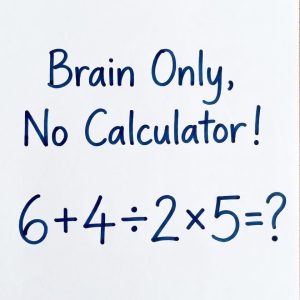
The correct answer is 16! If you got it right without using a calculator, congratulations! But if you arrived at a different number, you’re certainly not alone. The secret to solving this puzzle is remembering the order of operations, a mathematical rule taught in schools that determines which calculations must be completed first. Although the equation contains only addition, division, and multiplication, solving everything from left to right without considering those rules can lead to an incorrect answer.
Start with the original equation: 6 + 4 ÷ 2 × 5. According to the order of operations, multiplication and division take priority over addition. Importantly, multiplication and division have equal priority, so they must be performed from left to right. First, divide 4 by 2, which gives you 2. Next, multiply that result by 5, giving you 10. Finally, add the remaining 6. That gives you 6 + 10 = 16. It’s a straightforward process once you remember the correct sequence.
Why do so many people get these problems wrong? Often, it’s because they rush through the equation or misremember the rules they learned years ago. Some assume multiplication must always come before division, but that’s not correct. Others begin with the addition simply because it appears first. The key is understanding that multiplication and division share the same level of priority, just as addition and subtraction do. When operations have equal priority, you work from left to right unless parentheses or other grouping symbols change the order.
These little brain teasers are a fun way to exercise mental arithmetic and revisit lessons many of us haven’t thought about since our school days. They also remind us that the simplest-looking questions sometimes require the most careful attention. Whether you solved it instantly or needed a second attempt, the important thing is understanding why the answer works. Now it’s time to challenge your friends and family and see whether they remember the same mathematical rule!



This Post Has One Comment