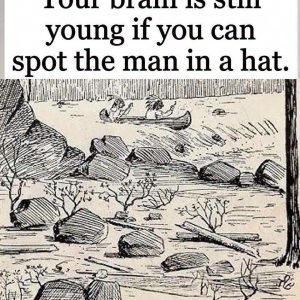
This fascinating vintage optical illusion has captured attention because it transforms an ordinary landscape into something completely unexpected. At first, viewers see rocks, fallen logs, trees, and a peaceful stretch of water. A canoe carrying two people draws attention toward the background, making the picture appear like a simple countryside illustration. But the artist has cleverly arranged elements of the scenery to create another image: the face of a man wearing a hat. Unlike traditional hidden-object puzzles, the man isn’t a small figure concealed behind another object. His face is part of the landscape itself, making it easy to overlook.
The secret lies in how the rocks, darker areas, and spaces between objects combine to suggest familiar facial features. Certain curves can resemble a forehead, while shadows create the appearance of eyes and other details. When these shapes are viewed together rather than separately, the larger image begins to emerge. This effect is related to a phenomenon called pareidolia, which occurs when the brain recognizes familiar patterns, especially faces, in shapes that might otherwise appear unrelated. It’s the same reason people sometimes notice faces in clouds, tree trunks, or unusual rock formations. The shapes don’t change, but our interpretation of them does.
If you’re struggling to find the hidden man, try looking at the illustration from a different perspective. Instead of concentrating on every small rock or branch, move your eyes across the entire landscape. Stepping back from the screen may help you recognize larger patterns. You can also try squinting slightly, which reduces the distraction of smaller details and makes broader shapes more noticeable. Pay attention to the spaces between the rocks and shadows, and imagine how they might form the outline of a face. Some people also find it helpful to rotate the picture briefly before looking at it normally again. Most importantly, don’t let the canoe distract you from the larger illusion.
Although some online versions of this puzzle suggest that finding the man quickly proves you have a younger or healthier brain, there is no scientific basis for that conclusion. How quickly someone recognizes an optical illusion depends on many factors, including familiarity with similar puzzles, attention, image quality, and visual interpretation. It’s an entertaining observation challenge, not a medical test or an accurate measure of intelligence. The most enjoyable moment comes when the hidden face suddenly becomes recognizable. Once you notice it, you may wonder how you ever missed it in the first place. That’s what makes vintage optical illusions so memorable: they show us that a familiar picture can contain something unexpected when we change the way we look at it.
👀 Did you find the hidden man? Tell us how long it took you: 5 seconds, 30 seconds, or more than a minute!




This Post Has One Comment