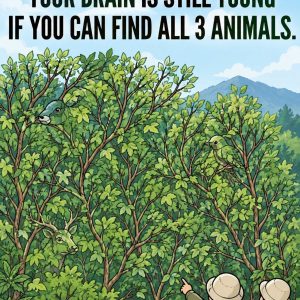
At first glance, the puzzle seems simple.
You spot the large hens almost immediately, quickly count them, and feel confident you already know the answer. That’s exactly where most people make the mistake. The image is designed to trick your brain into stopping too early, assuming the obvious count must be correct.
But the real challenge begins when you slow down and look closer.
Hidden among the feathers are several tiny chicks carefully blended into the scene. Some are tucked beneath wings, others hidden near legs or partially covered by the larger hens. A few are so small that your eyes skip right past them unless you deliberately scan every corner of the image.
That’s why so many people get stuck at 9 or 10 birds.
The puzzle isn’t really testing math — it’s testing attention.
Our brains naturally search for quick patterns and easy answers, especially under time pressure. Once we think we’ve “solved” something, we stop looking carefully. Optical puzzles like this take advantage of that habit by hiding details in places the mind assumes are already understood.
The correct answer is actually 15 chickens in total: 9 larger hens and 6 hidden chicks scattered throughout the picture.
And honestly, that’s what makes these puzzles so addictive.
They remind us how easily the brain can overlook what’s right in front of us simply because we believe we’ve already seen enough.