The secret to solving this puzzle correctly lies in understanding the order of operations. In mathematics, this principle is commonly called PEMDAS or BODMAS. These abbreviations help students remember that parentheses, exponents, multiplication, division, addition, and subtraction must be handled in a particular order. Without following these rules, even a simple expression can produce an incorrect result.
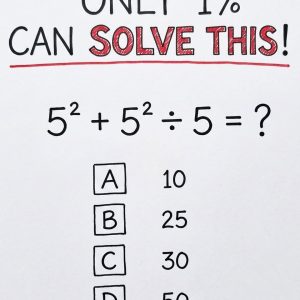
First, examine the two numbers written with exponents. The expression 525^2 means five multiplied by five, which equals 25. Because the equation contains this expression twice, both must be replaced with 25. After completing that step, the original equation becomes:
This is where the most common mistake happens. Some people immediately add 25 and 25, producing 50, and then divide that number by five. Their final answer becomes 10. Although the arithmetic itself is correct, the procedure violates the order of operations. Division has priority over addition, so the division must be completed first.
Begin by dividing 25 by five. The result is five. Now the equation becomes 25+525+5, leaving only one operation to complete. Adding these numbers produces 30. Therefore, the correct answer is C) 30. The other choices may appear convincing, particularly when someone solves the equation too quickly, but they do not follow the required mathematical rules.
Puzzles like this provide an enjoyable opportunity to refresh basic mathematical skills. They remind us that solving problems correctly is not always about calculating quickly. Sometimes, carefully examining the details and following established principles makes all the difference.
The lesson is simple: accuracy matters more than speed. Even the easiest-looking mathematical challenge can become confusing when we overlook a fundamental rule.



This Post Has One Comment